Monday, February 13, 2012

On Media, New and "Old"

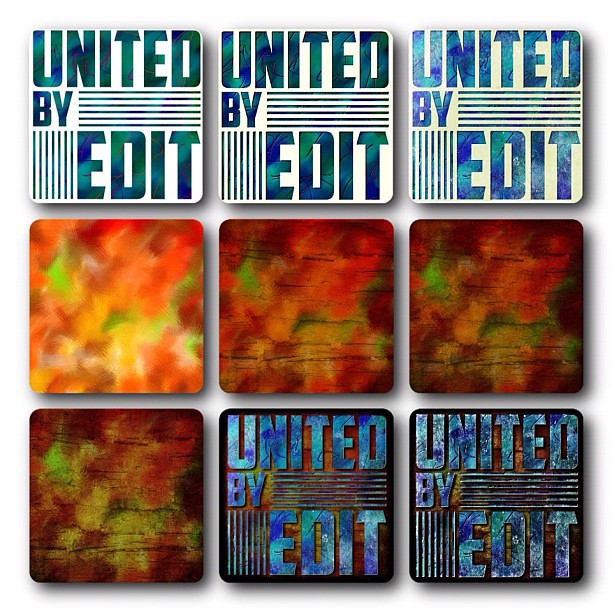
I made this as a part of a the "United By Edit" logo competition on Instagram.  No photos were used (or harmed) in the making of this image.

Ever feel like you are a social movement of one?  I know the feeling.  And of course, the irony of those two sentences is that they contradict: If there's two of us, we are no longer alone.

Click to enlarge to see a bit of my process in making this.
Now that we've limbered up with a little verbal calisthenics, let me get to my point.  I feel like I am waging a private war at times against the presuppositions of photography in  online image sharing.  The preponderence of sites (Twitpics, Flickr, Instagram, Picasa, etc.) default in their language to the idea of sharing photography, when a cursory glance through people's feeds suggests something more interesting is going on here. 

On Instagram, I participate in groups like #we_edit and #unitedbyedit, formed in part in response to photography groups who regularly criticize "too much honey" in a photo edit.  But even in these groups, photography is not always the base.  Plenty of folks are working with digital graphics apps and software that allow them to render from scratch or modify other captured content (preferrably open source or Creative Commons, but admittedly, not always). 

Actually began as a photo, but made to look painted.
Then too, many apps and software packages still predominantly identify their filters and effects by the ways they (roughly!) approximate darkroom procedures for retouching photographs.  "Burn," "dodge," "vignette," "HDR," "Orton," and so forth have become common parlance in digital photo editing -- although the results are often quite different from their print photography analogues.

Now don't get me wrong: I am not against digital photography or its imitations of its analogue ancestor.  And I see the value, on paper or on screens, of the minimally edited photograph.  But as we celebrate the ways tablet and smartphone technologoes are opening up people's creativity and generating "new" art movements (c.f. "iPhoneography"), I think it behooves us not to be too beholden to the familiar and to acknowledge the plethora of image creating possibilities these tools allow.

I think the real inovation of these tools is less the camera (although that is part of it, but certainly also available on lower IQ phones) than the screen.  The screen is increasingly how we frame our shots (as opposed to the analogue and early DSLR view finder).  It is also where we edit and view most images (since only very few of us print out our pics, and then only very few those, relatively speaking).  But it is also where we forgo the camera entirely to use stylus or finger to draw, paint, clip, and blend images.

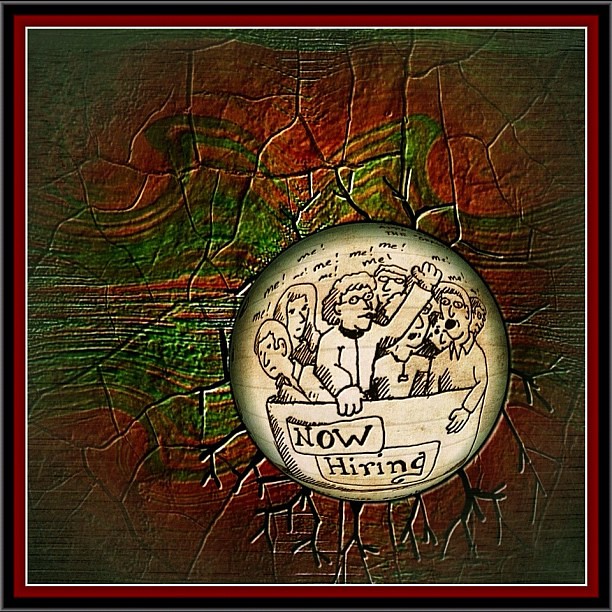
So, there's a photo of a drawing in this one?
So what are the better terms?  What is a little less beholden to the way things were, a little more responsive to extant practice, and a little more visionary for the future.  Increasingly, I use "pic" (the online-savvy abreviation of "picture")  or "image" when talking about the images I create and share.  These may be photographs, may include photographic elements, or may never have involved a lens in the process at all.  I also object to "edit" as the default term for image manipulation since it implies some photographic original that I am revising and reworking, some qualitative distinction between making an image and revising it.  Instead of "edit," maybe we should call this work "pixel pushing."  Leaving aside vector graphics for the moment, "pushing" seems to capture both the sense of moving and also the sense of transforming through filters the basic structure of the digital image: the pixel.  "Pixel pushing" captures the idea of edit and of paint, and it frees us from the erroneous perception that we are engaged in anything really like darkroom editing.

Maybe this is all just a matter of semantics.  The "photo" in "Photoshop" hasn't stopped artists from using it even when they don't have a photograph to build on.  More people use Instagram than those using digital "Instamatics" or their imitators.  And every time someone complains about someone else's aesthetic or use of a tool, the offender tends to form communities as reaction formations to arbitrary rules.  Making art is frequently about breaking rules and using tools in ways other than they were intended.  No harm, no foul.

Click to enlarge some of the steps.
Even so, now might be a time to lift up our heads and take a good look at what is going on.  Something is changing in our capacity to make and circulate images.  The camera in your phone that is also a phone that is also a powerful computer....is also a powerful digital arts studio.  This combinatory morphing, this portability, and this digital ephemerality of the final work is creating truly new media, something that owes much to the predecessors we can name but something also significantly different.  With or without the social movement of one or many, our practices are leading the way into fascinating territory. 

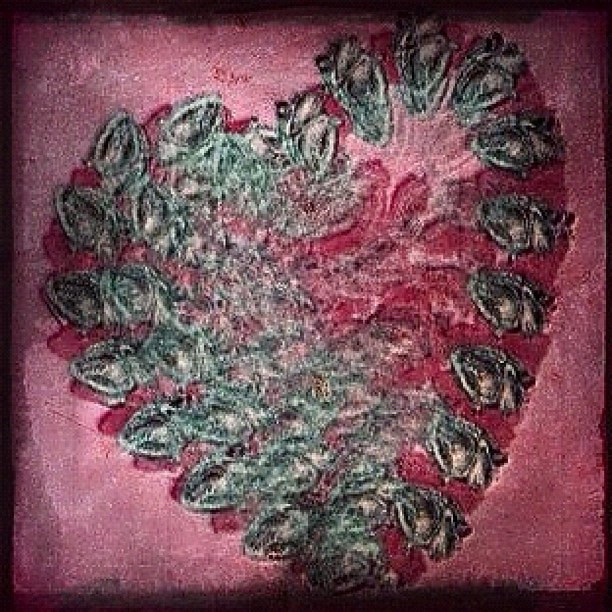
Your Heart of Hearts.  Made with a digital brush made from a heart diagram.  
Happy Valentines Day!

Saturday, February 4, 2012

Graveyard Theme and Variation


Last week I posted about my recent discovery of the folks making and sharing horror-themed pictures on Instagram. That group is still on my mind, apparently haunting the corners of my daily practice. As an extension of my prescient remix culture theme, this past week @horrorclub posted a picture to be used in a "challenge" titled #bloodstained_challenge1. The gist of these challenges is that you copy the prompting picture and rework it. Many challenges simply post regular highlights of participants' contributions. Some, like this one, create a mechanism for picking a winner from all the entries.


I would be lying if I claimed i was not interested in highlights and winning, but at least I try not to lead with that care. My primary interest is in the prompt and seeing how many different ways I can rework that opening picture. I also enjoy seeing what others do with it. But mostly, it's the combination of the assignment and the communal sharing that keeps me going.

There is something revealing in that observation: see, I've always thought I was a much better student than an academic. There comes a point in graduate school where you have to move beyond assignments and homework, but not the work. You have to start designing your own prompts, your own research projects. I found that transition hard; I still struggle with it. I've tried to formalize giving myself prompts, asking myself questions as if I was both teacher and student. It doesn't really work so well.


I'm not sure exactly what I get from an assignment prompt that I can't provide for myself. Alibi, maybe? In the case of these horror edits, I feel like both the sponsor and the group of folks contributing to the feed licenses some pretty dark stuff. If I were just doing this on my own, you might think I needed psychiatric help. Well, you probably still do. But in my head, my imagined you is less judgmental because I am not doing this alone. No, instead I've joined a creepy zombie cult of goth kids and misfits. So much better.

It is better, because those goth kids and misfits have got my back. We sneer at all of you squares and dweebs who "just don't get it." Again, not really. This is a psychological alibi. These are my hipster, imagined artist friends who hang out smoking id cigarettes by the dumpsters in back of the consciousness cafeteria.


Dark fantasies all around.

But so, horror is a comfort for me. I retreat to it, not for its violence and gore, but for its familiar formulas and the constant play of convention and invention in any genre. I love its playful yet sinister dare: go ahead, disbelieve this "hokum" -- you know what happens to the disbelievers. Again, not in real life -- well, usually not in real life. That's the tension of possibility right there. That's the dance of "you're being silly and superstitious" with "maybe there really are monsters, this time."

Okay, while I'm on the confession train, here's another fact about me: I love graveyards. I love going to them at all hours of the day and night, including midnight and after. They are, to me, more peaceful and spiritual than churches or mountaintops. They are spaces to confront possibility, to walk the knife's edge between what is and what might be, to feel the tug of superstition and the supernatural at the edges of a mind struggling always to be rational. They are sites of honoring the departed, remembering that they matter, and confronting how little they actually stay with us. They are places to witness others' attempts to remember and honor the departed, to see that as a performance in regular need of refreshment. Wherever I have lived, I have always known where the nearest graveyard is and visit it regularly.


Graveyards are a kind of prompt, a kind of invitation. We go there to work our magic, to imagine so many possibilities, both dark and comforting. A faded epitaph is its own kind of writing assignment, waiting to be fleshed out. Fresh and withered flowers and wreaths are the tokens of others' offerings to the cemetery seminar. And each shadow is a theater where fantasy performs, sometimes sinister and sometimes serene.

You might worry about the darkness in my soul, but I promise it is balanced by light. My recent picture manipulations are more signs of joy than despair. These are the formulae, the incantations of possibility and a deep belief that myth matters. These monsters that go in and out of fashion never go away. Like prayers or angels, they remind us that there is something more all while teasing us that to think so is silly. Or is it?

And so we whistle, breath and melody, its own kind of prayer, walking a little more quickly or a little more slowly past sites of so much possibility.


Friday, January 27, 2012

Of Monsters, Copyright, and Control

Even as the semester gets off to a more hectic than usual start, I still find time to maintain a presence on Instagram.  The iPad has truly become my portable electronic "sketchbook," with photo editing and pixel pushing replacing my usual pen on paper practice.  Mourn that if you want, but I embrace anything that keeps my creative brain engaged and active...alive! 

Lately, I've found the horror fans on IG who like to edit with a darker sensibility (see especially the hashtags #appnormal and #horrorclub on IG).  I have a long-standing interest in horror as literary, theatrical and cinematic genre.  There is something enticing to me about a surreal aesthetic as visceral as it is playful, the gut-pull of gore and gross.  I subscribe to the notion that it is better to work these dark fantasies out on the page and stage, in words and images, than it is to do so on ourselves and each other.  Let us let off the fetid steam of our shadow-selves in art rather than actual violence.  Let us contemplate mortality as much with dark fantasy as with bright myths of redemption; let us not imagine these are mutually exclusive possibilities.

But there is something nibbling at my soul with my recent practice that yearns for some explanation as well as illustration.  Lately, I have been reworking a lot of images found at the open-source vintage photo archive, IndiCommons.  These images are in the public domain; they are expressly (though not primarily) made available for the aesthetic and ethic of Remix Culture. What I do here with these images is not illegal, in the strictest sense.

But is it defensible on other levels?  What does it mean to take the images of real people I have never known (but who are likely meaningful to their surviving descendents) and rework their visages in a grotesque aesthetic.  Is this a kind of "piracy," a visual violence and semiotic transgression that so much copyright or defamation legislation is meant to prevent?  How would I like it if my image were similarly distressed and presented as the proud accomplishment of someone else's twisted imagination?

Let me answer that last question first: I welcome it!  I would be flattered.  And even if I were disturbed by the tenor of the edit (say, mocking my sexuality with homophobic stereotypes), I still welcome that impulse played out with pixels rather than, say, a tire iron in a back alley.  (Caveat:  Here I would, however,  mark a murky but important distinction between disturbing imagery and visual defamation targeted at an individual or minority group.)  But I don't simply say this as evidence of a cavalier attitude about my own image or some narcissistic notion that any publicity is good publicity. I remind myself that, despite our best proprietary efforts, we always have so little control over what is done with our images, our words, and what we think they mean when we release them into the chaos of our shared interactions with others.  Anything that reminds us of that fundamental truth in a regular, deep-knowing way is important.  

This practice of using what we find, to me, is a central tenet of Remix Culture.  This practice is not necessarily a form of piracy or visual defamation; rather, it is the way human creativity has always worked.  The notion of authorship and artistic ownership is a relatively recent invention of humanity.  No, I am not advocating that one simply take someone else's work and slap one's name on it and claim (and therefor profit from) it as one's own.  However, reworking an idea or even the work of someone else into something new is what we do, have always done, as a species with a highly developed sense of social organization.  Call it memes, call it culture! We not only create, we recreate -- we recycle the dead, sometimes before they are even dead. 

If you are disturbed by these images not so much because of the tropes of the horror genre but because of the sources they are built from, take a lesson from the strangeness you feel.  Think about the images you have put out there on the Web -- images of your children, your loved ones, your vacations, your home, yourself.  Know that in sharing them you have released them to the myriad practices of humanity; know that you have no control over how others are not only viewing them, but using them.  In some dark dungeon, some monster may be drooling over your image, seeking ghastly and uspeakable pleasures in ways you don't want to think about.

So.  Stop posting?  Stop sharing?  Try to figure out ways to lock your works up so they can only be viewed and used the way you intended?  Yeah, good luck with that.  Do so, and you may very well limit your ability to share or even view in the ways you have become accustomed -- you may well find yourself endorsing draconian and ill-conceived legislation like SOPA and PIPA.  And the thing is, even if you do so, the monsters will still be out there, lurking -- feeding their (our?) dark desires in so many other ways.

Rather, let go.  Don't stop worrying about the monsters, necessarily, but be more vigilante about them when they actually come out of their dungeons, when they threaten real damage to you and/or your loved ones.  For sure, try not to give them your address!  Share online only that which you would share in a public space.  Don't be seduced by illusions and false assurances of control.  Stop worrying about what others do with images, with words, that stopped being "yours" (if they ever truly were) the moment they were released into the public.  In your efforts to protect yourself, don't confuse the monsters with the artists...and try always to be the latter.

As for the laws regarding rights (copy- or otherwise), respect them or suffer the consequences.  This is always the case, even with stupid laws.  But fight the stupid ones.  For they, too, create monsters.